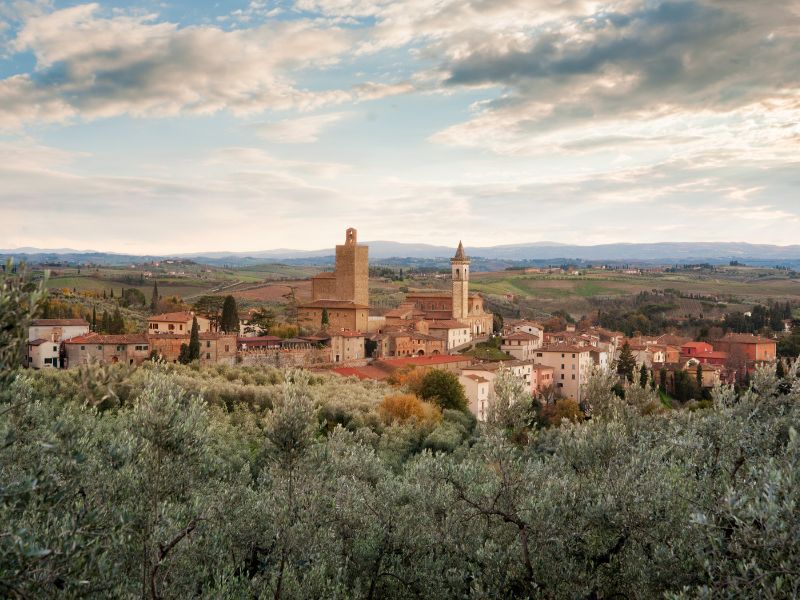
Vinci is known worldwide as the birthplace of Leonardo da Vinci, but this charming Tuscan town offers more than history, it’s a living tapestry of art, culture, and nature.
Wander its cobblestone streets, discover artisan workshops where skills have been passed down for generations, and soak in the gentle rhythm of Tuscan life.
From quaint cafés to hidden tiny piazzas (squares), Vinci invites visitors to slow down, explore, and connect with the authentic spirit of Tuscany.
Vinci through the ages: Leonardo, legacy and the vine
Vinci, perched on the gentle slopes of the Montalbano hills between Florence and Pistoia, has a history as rich and layered as the vineyards that surround it. Its name is believed to derive from the “Vinco” or “Vincastro,” a type of willow tree once common in the area, whose supple branches were traditionally used to tie vines after pruning.
The town’s medieval identity is still visible in the imposing Rocca dei Conti Guidi, a hilltop fortress founded around the year 1000, and in the church of Santa Croce, which is documented as early as the 12th century.
Yet Vinci is most celebrated as the birthplace of Leonardo da Vinci, born on April 15, 1452, in the nearby farmhouse of Anchiano, just a few kilometers from the town center; raised in a humble but intellectually rich environment, Leonardo spent his early years absorbing the rhythms of the Tuscan countryside, its hills, olive groves, and vineyards, elements that would deeply influence his thinking and artistry.
Leonardo self portrait – Torino
As he matured, Leonardo’s genius took him far beyond Vinci: he became not only a painter and inventor, but also an observer of nature, anatomy, engineering, and agriculture; his life later carried him to Milan, where in 1498 his patron, Ludovico Sforza (known as “Il Moro”), granted him a vineyard of around 16 rows (about one hectare) near what is now the Casa degli Atellani, close to the refectory of Santa Maria delle Grazie, where Leonardo painted The Last Supper.
This vineyard was not merely a decorative gift: it symbolized a connection between Leonardo’s Tuscan roots and his new life in Milan. Leonardo tended to it, leased it for a time to his apprentice Salai, and even after political upheaval, with Milan falling to the French, he managed, through persistence and legal claim, to reclaim it. In his will, Leonardo divided the vineyard between Salai and his faithful servant Giovanbattista Villani. Centuries later, in a remarkable act of historic and scientific resurrection, botanists and geneticists excavated the site, identified fragments of root material, and replanted Malvasia di Candia Aromatica, the same grape variety Leonardo cultivated.
Back in his hometown, Vinci honors this legacy through its Museo Leonardiano, housed in both the Guidi Castle and the Uzielli building, where visitors can explore scale models, facsimiles of his manuscripts, and interactive exhibits that commemorate his work as an engineer, scientist, and thinker. Moreover, the Casa Natale di Leonardo in Anchiano, reachable by a scenic path called the “Strada Verde”, welcomes guests into the very space that shaped his earliest insights, with displays that underline his profound bond with nature and his native Tuscan landscape.
Today, Vinci’s countryside remains remarkably intact, covered in olive groves and terraced vineyards that reflect the same rural harmony Leonardo knew as a child. In fact, his influence lives on in the local wine world: the Cantine Leonardo da Vinci cooperative, founded in 1961, cultivates hundreds of hectares around the hills of Montalbano, producing wines that pay tribute to the visionary spirit of their namesake.

Leonardo, “The Last Supper” – Milano
Thus, the story of Vinci is not only a story of art and innovation: it is a living tale of land, cultivation, and a genius who, even beyond his extraordinary inventions, found beauty and inspiration in the simple, grounding act of growing grapes.
Local culture and traditions
Vinci’s local culture is deeply rooted in its agricultural traditions and its close connection to Leonardo da Vinci. The town’s rhythm is shaped by centuries-old practices, especially through its vineyards and olive groves, which form the backbone of the Strada dell’Olio e del Vino del Montalbano, or “Leonardo’s Hills” Road.
These gently rolling hills produce several typical local varieties, Sangiovese, Canaiolo, Malvasia Nera for red wines, and Trebbiano and Malvasia Bianca for white wines. During the warmer months, the community comes alive with Le Notti del Vino (The Nights of Wine), a series of summer evenings organized in partnership with the national “Cities of Wine” association and supported by local producers and cultural associations.
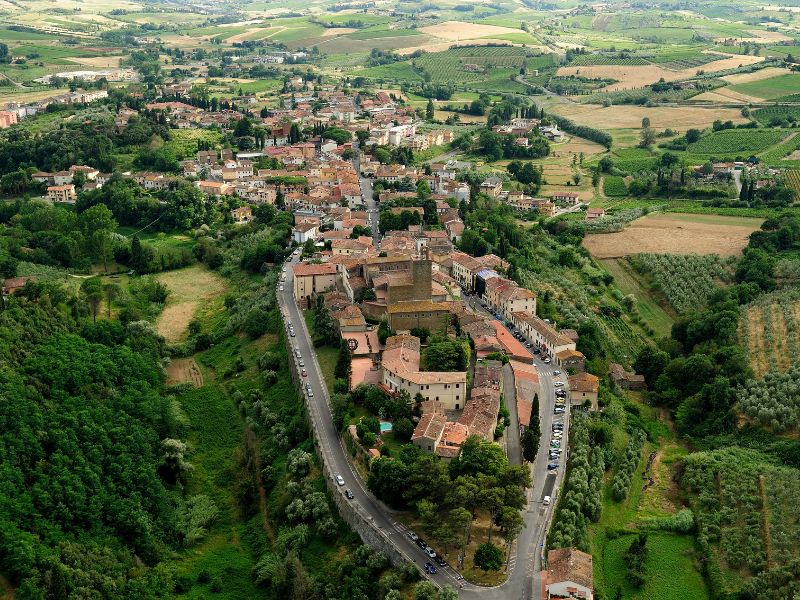
Aerial view of Vinci
These events blend wine tastings, live performances, and outdoor cinema, often set in the evocative spaces of Vinci, such as Piazza della Libertà, the house of Leonardo in Anchiano, or under the cypress trees of Dianella.
Tradition also finds expression in annual festivals: on the last Wednesday of July, a historical procession re‑enacts the tale of Captain Cecchi Santi , a soldier who, according to local legend, was thrown from the Guidi Counts’ tower for a betrayal born of love, but miraculously survived “flying” to the opposite hill thanks to a glass of wine.
Meanwhile, the Festa dell’Unicorno (Unicorn Festival), held on the last weekend of July, transforms Vinci into a medieval fantasy stage, welcoming crowds of comic and fantasy fans with costumed parades, thematic areas, and street performances.
Culinary traditions are equally central: local dishes such as pappa al pomodoro, farro soup, and farinata made with black cabbage reflect the simple authenticity of Tuscan rural cuisine. At the same time, the olive groves on the higher slopes of Montalbano produce a prized extra-virgin olive oil, especially from Moraiolo and Leccino varieties, with a taste that is spicy, herbal, and unmistakably Tuscan.
Many of these local products can be tasted in family-run farms and agriturismo, where guests are invited to slow down, stroll through vineyards, and savor olive oil in a relaxed, authentic setting.
This mix of history, gastronomy, and community-driven festivals gives Vinci a living cultural identity: one that doesn’t just celebrate its past, but invites both visitors and locals to participate in traditions that are still very much alive, especially through wine, olive oil, and the land that Leonardo himself once walked.
WHY VISIT THE VINEYARDS?
Exploring Vinci’s vineyards is more than just a visual delight, it’s an immersive experience.
Walking among the neatly lined rows of grapevines, visitors can feel the intimate connection between land, climate, and human care.
Each bottle of wine produced here carries the essence of the hills, the warmth of the Tuscan sun, and the dedication of local vintners.
Tasting these wines is tasting the land itself, a journey that engages all the senses and deepens one’s understanding of Tuscany’s unique terroir.
“Why just visit when you can become part of the land itself?”
With the “Adopt a Vineyard Row in Tuscany” program, you can follow the vine you’ve chosen through every season, from budburst to harvest, experiencing the joys and rhythms of Tuscan winemaking firsthand.
It’s more than a gift or a trip; it’s a personal connection to Tuscany, a story you can watch grow year after year, right from the heart of Leonardo’s homeland.